

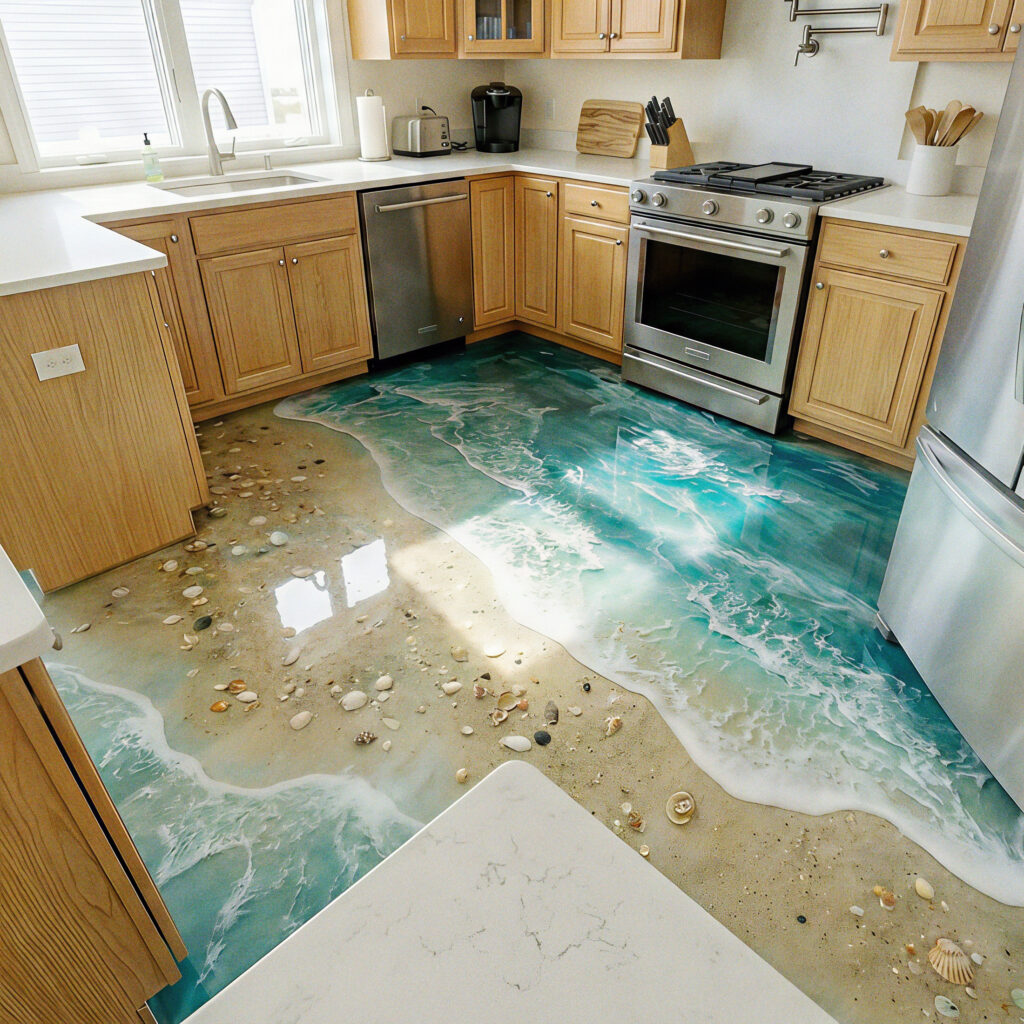
At first glance, this kitchen looks like any other standard space. Wood cabinets, neutral counters, a familiar layout. But the transformation begins from the ground up, starting with the idea that the floor itself could become the focal point of the room — not just something you walk on, but something you experience.
The goal here isn’t to recreate the ocean perfectly. It’s to create the feeling of standing at the edge of water, where sand meets tide, frozen in motion beneath your feet.
Preparing the Space From Scratch
Before anything visual happens, the room has to be completely sealed and protected. Cabinets, appliances, and counters are carefully wrapped to isolate the work area. The existing flooring is stripped back and leveled, creating a smooth base that can support multiple poured layers without shifting or cracking.
Once the surface is prepared, a textured base layer is applied to form the shoreline. Fine aggregates and sand tones are worked into the floor by hand, giving it depth and natural variation. Small stones and shells are placed deliberately, not scattered, to guide the eye the same way a real beach would.


Building the Water in Layers
The “water” effect comes later. Translucent layers are poured gradually, each one tinted slightly differently to create depth. Lighter tones sit near the edges, while deeper blues pool toward the center of the space. Between pours, the surface is manipulated by hand to form gentle movement — subtle currents, soft ripples, and the suggestion of waves pulling back toward the sea.
White accents are added sparingly to create the appearance of foam, as if a wave has just broken and is slowly retreating. Nothing is rushed. Each layer cures before the next is added, locking the motion in place.
Sealing the Illusion
Once the scene is complete, the entire floor is sealed beneath a clear protective finish. This final layer brings everything together — smoothing the surface, deepening the colors, and making the floor fully functional for everyday use.
What’s left is a kitchen that feels permanently connected to the shoreline. The cabinets and appliances stay familiar, but the floor quietly changes how the space feels. It grounds the room, both visually and emotionally, turning something practical into something immersive.

A Concept Rooted in Feeling
This kind of design isn’t about novelty. It’s about atmosphere. About bringing a sense of calm, movement, and place into a room that’s used every day. The result feels less like a statement and more like an experience you live with — one step at a time.


This is gorgeous ! Do you do this in peoples houses and how much does it cost? Where are you located?
These are just design ideas we hope to one day bring to reality! We are based in Nashville, TN. Thank you for the comment!
-Original Cozy